
-
By LIjo James
-
June 19, 2026
- 0 Comment
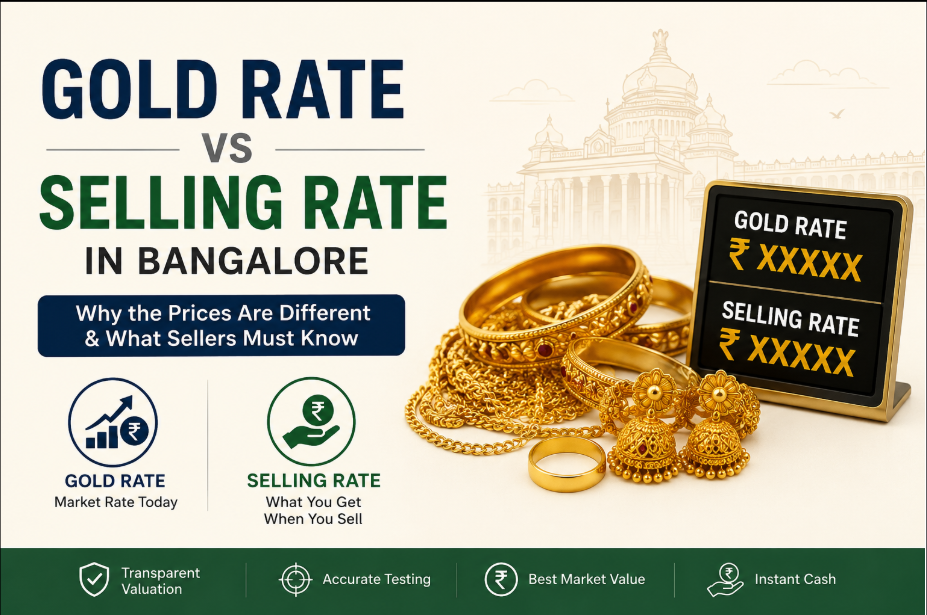
Gold Rate vs Selling Rate in Bangalore

LIjo James
Lijo James – Internal Auditor & Gold Appraiser With over 10 years of experience, Lijo James is a seasoned Internal Auditor and Gold Appraiser specializing in the gold market. His expertise lies in conducting detailed gold market studies, ensuring accurate appraisals, and implementing robust auditing practices. Lijo’s in-depth knowledge of gold trends and market dynamics enables him to deliver reliable insights and maintain high standards of financial accountability. Dedicated to precision and integrity, he consistently ensures compliance with industry regulations while optimizing processes. His commitment to excellence makes him a trusted professional in the gold appraisal and auditing sector.
Read full bio of LIjo JamesMany people in Bangalore check today’s gold rate online and expect to receive the same amount when selling old jewellery. But when they visit a gold buyer, the quoted selling rate may be different. This often creates confusion.
A common question sellers ask is: “Why is my jewellery valued lower than today’s gold rate?”
The answer is simple: the gold rate and the gold selling rate are not the same. The gold rate usually refers to the market price of pure gold, while the selling rate depends on purity, weight, hallmark status, testing results, deductions, and the current resale value of your gold.
This difference matters especially for people planning to sell old jewellery, inherited ornaments, gold coins, or pledged gold in Bangalore. Whether you are comparing Gold Buyers in Bangalore, checking the old gold selling rate in Bangalore, understanding how resale value works can help you avoid confusion and get a fair valuation.
In this guide, we will explain:
- What gold rate means
- What selling rate means
- Why selling price is lower than market rate
- How gold buyers calculate gold value
- How purity affects resale price
- Why making charges and GST are not recovered
- How Bangalore sellers can get the best price
What Is the Gold Rate in Bangalore?
The gold rate in Bangalore refers to the market price of gold on a given day. This rate changes daily based on international gold prices, currency movement, demand, taxes, and local market conditions.
When people search for gold rate today Bangalore, they usually see prices for:
- 24K gold
- 22K gold
- Sometimes 18K gold
Simple Gold Rate Table
Gold Type | Purity Level | Common Use |
24K Gold | 99.9% pure | Coins, bars, investment gold |
22K Gold | 91.6% pure | Jewellery |
18K Gold | 75% pure | Designer jewellery |
14K Gold | 58.5% pure | Lightweight jewellery |
24K gold is the purest form, but it is generally too soft for regular jewellery. Most jewellery sold in India is 22K or 18K because it is mixed with other metals for strength.
So, when you see the gold rate online, it may not directly apply to your jewellery unless the purity and weight are verified.
What Is the Gold Selling Rate?
The gold selling rate is the amount a buyer offers when you sell your gold. It is also called gold resale value, old gold valuation, or gold buying rate.
Featured Snippet Answer
The gold selling rate is the resale value offered for old gold jewellery, coins, or ornaments. It is calculated based on purity, weight, current market gold rate, testing results, and applicable deductions. It is usually different from the online gold rate because jewellery includes making charges, GST, stones, and purity variations.
For example, if today’s 24K gold rate is high, your 22K jewellery will still be valued based on its actual purity, not the 24K rate. Similarly, if your jewellery includes stones, enamel, or non-gold parts, those may be deducted from the final weight.
This is why gold resale value in Bangalore depends more on testing and calculation than only on the rate shown online.
Gold Rate vs Selling Rate: Key Differences
Factor | Gold Rate | Gold Selling Rate |
Purpose | Market reference price | Resale value offered to seller |
Purity | Usually shown for 24K or 22K | Based on tested purity |
Making Charges | Not included in resale | Usually not recovered |
GST | Paid during purchase | Usually not refunded |
Market Value | General market benchmark | Buyer’s valuation after testing |
Resale Calculation | Based on market price | Based on purity, weight, and rate |
The main difference is that the gold rate is a benchmark, while the selling rate is a practical valuation after checking the actual gold content.
Why Is the Gold Selling Rate Lower Than the Gold Rate?
This is the most important part for sellers to understand. A lower selling rate does not always mean the buyer is cheating. In many cases, the difference is due to normal resale factors.
Making Charges Are Not Recovered
When you buy jewellery, you pay for gold plus making charges. Making charges cover design, labour, craftsmanship, wastage, and brand margin.
But when you sell jewellery, buyers usually pay for the gold content, not the design work.
For example:
Purchase Component | Recovered During Resale? |
Gold Value | Yes, based on purity and weight |
Making Charges | Usually no |
GST | Usually no |
Stone Value | Depends on buyer and item |
Brand Premium | Usually no |
This is one of the biggest reasons gold jewellery resale value is lower than the purchase price.
GST Is Not Refunded
When you buy gold jewellery, GST is added to the invoice. But when you sell old gold, the GST paid during purchase is generally not returned to you.
So even if the gold rate has increased, the original GST component does not usually come back as part of resale value.
Purity Variations Affect Price
Many sellers assume their jewellery is 22K because it was purchased as 22K. But actual purity may vary depending on the item, age, soldering, alloy mix, and previous repairs.
This is why German XRF gold testing is important. It helps identify the actual purity before calculating the final amount.
Stone Weight Deductions
Jewellery often includes:
- Stones
- Beads
- Enamel
- Lac
- Hooks
- Screws
- Non-gold decorative parts
These parts may increase the total jewellery weight, but they are not pure gold. During resale, buyers calculate the value mainly for the actual gold content.
Market Spread
Gold buyers may maintain a buy-sell spread. This means the rate at which they buy gold may differ from the retail market rate. The spread can depend on purity, refining, operational costs, and business policies.
That is why two buyers may offer different prices for the same ornament.
How Gold Buyers Calculate Gold Selling Rate in Bangalore
Professional gold buyers in Bangalore usually follow a step-by-step valuation process.
Step 1: Gold Testing
The jewellery is first tested to identify its purity. Modern buyers often use XRF testing because it is non-destructive and gives quick purity results.
Step 2: Purity Verification
The purity result shows whether the jewellery is 24K, 22K, 18K, 14K, or another purity level.
Step 3: Weight Measurement
The jewellery is weighed using a digital scale. If there are stones or non-gold parts, they may be separated or deducted depending on the item.
Step 4: Live Gold Rate Check
The current market rate is checked before calculating the value.
Step 5: Final Valuation
The final gold selling price is calculated based on:
- Net gold weight
- Purity percentage
- Current gold rate
- Applicable deductions
Simple Formula
Gold resale value mainly depends on:
Net Gold Weight × Purity Percentage × Current Gold Rate
This is why two ornaments of the same weight can receive different prices if their purity levels are different.
How Purity Affects Gold Selling Price
Purity is one of the biggest factors influencing the old gold selling rate in Bangalore. Even if two jewellery pieces weigh the same, their resale value can be very different if their purity levels differ.
Gold jewellery is rarely made from pure gold alone. Other metals such as silver, copper, zinc, or nickel are mixed with gold to improve strength and durability.
The higher the gold content, the higher the resale value.
Gold Purity Comparison
Gold Type | Purity | Gold Content |
24K Gold | 99.90% | Highest |
22K Gold | 91.60% | High |
18K Gold | 75% | Medium |
14K Gold | 58.50% | Lower |
Example
Imagine two gold chains weighing 50 grams each:
Jewellery | Purity | Estimated Gold Content |
Chain A | 22K | 45.8 grams |
Chain B | 18K | 37.5 grams |
Although both weigh 50 grams, Chain A contains more pure gold and will receive a higher valuation.
This is why professional gold buyers in Bangalore always test purity before providing a quote.
Real Bangalore Examples: Gold Rate vs Selling Rate
Many sellers understand the concept better through practical examples.
Let’s look at some realistic scenarios.
Case Study 1: 22K Wedding Jewellery
Customer
Family from Jayanagar
Item
22K Wedding Jewellery Set
Weight
80 grams
Situation
The family checked today’s gold rate online and expected the same value.
Valuation Process
- XRF Purity Testing
- Weight Verification
- Stone Deduction
- Live Gold Rate Calculation
Result
The valuation was based on actual gold content rather than the gross jewellery weight.
The family learned that making charges paid during purchase were not part of resale value.
Case Study 2: Hallmarked Gold Coins
Customer
Professional from Koramangala
Item
24K Gold Coins
Weight
30 grams
Valuation Process
- Hallmark Verification
- Purity Testing
- Current Market Rate Check
Result
Because the coins had high purity and no stones or design deductions, the valuation closely reflected prevailing gold rates.
How to Get the Best Gold Selling Price in Bangalore
If your goal is to maximize value, following simple steps can make a significant difference.
1. Compare Multiple Buyers
Never accept the first offer immediately.
Comparing valuations helps you understand:
- Market value
- Purity assumptions
- Transparency levels
2. Ask for German XRF Testing
Advanced purity testing provides accurate information about your jewellery.
This helps reduce uncertainty and improves confidence in valuation.
For more details, read:
XRF Gold Testing vs Acid Testing
3. Check Today’s Gold Rate
Review current gold prices before visiting any buyer.
You can also monitor:
Gold Rate Today in Bangalore
This gives you a benchmark before requesting valuation.
4. Understand Deductions
Ask questions such as:
- Are stones deducted?
- Are there processing charges?
- How is purity calculated?
- How is the final amount determined?
Transparent buyers should clearly explain every step.
5. Sell Hallmarked Gold
Hallmarked jewellery often creates additional confidence during valuation.
To understand the impact of hallmarking, read:
Hallmarked vs Non-Hallmarked Gold
6. Maintain Documentation
Although many sellers can sell jewellery without an original bill, keeping documentation whenever possible helps streamline the process.
For more information, see:
Sell Gold Without a Bill in Bangalore
Gold Loan vs Selling Gold: Which Is Better?
Many Bangalore residents struggle with this decision.
Should you pledge your jewellery or sell it?
The answer depends on your objective.
Gold Loan
Advantages
- Retain ownership
- Access short-term funds
- Recover jewellery later
Disadvantages
- Interest payments
- Loan repayment obligations
- Risk of auction if overdue
Selling Gold
Advantages
- Immediate liquidity
- No future obligations
- No interest payments
Disadvantages
- Permanent transfer of ownership
Which Option Is Better?
Choose a Gold Loan If:
- You need short-term funds
- You plan to recover the jewellery
- The jewellery has emotional value
Consider Selling If:
- The jewellery is unused
- You no longer need the asset
- You want permanent liquidity
For pledged jewellery options, explore:
Pledged Gold Buyers in Bangalore
Common Myths About Gold Selling Rates
Many misconceptions prevent sellers from making informed decisions.
Myth 1
“I will receive today’s 24K gold rate for my jewellery.”
Reality
Your jewellery is valued based on tested purity, not simply the published 24K market rate.
Myth 2
“Hallmarked jewellery always gets the same price everywhere.”
Reality
Purity testing, business policies, and transparency levels can influence valuation.
Myth 3
“Making charges increase resale value.”
Reality
Making charges are usually paid during purchase and generally not recovered during resale.
Myth 4
“Broken jewellery has less value.”
Reality
Gold value depends primarily on purity and weight, not appearance.
Myth 5
“Selling gold without a bill is impossible.”
Reality
Many customers successfully sell inherited and family jewellery after completing verification requirements.
Bangalore Seller’s Checklist Before Selling Gold
Before selling old jewellery, use this simple checklist:
✅ Check Today’s Gold Rate
Monitor current gold prices before visiting any buyer.
✅ Verify Purity
Understand whether your jewellery is:
- 24K
- 22K
- 18K
- 14K
✅ Ask for XRF Testing
Ensure purity is verified through reliable testing.
✅ Compare Multiple Buyers
Obtaining multiple valuations helps you understand market value.
✅ Understand Deductions
Ask for a complete breakdown of calculations.
✅ Carry Identification Documents
Commonly accepted documents include:
- Aadhaar Card
- PAN Card
- Passport
- Driving Licence
✅ Understand Ownership Requirements
Especially important for:
- Inherited gold
- Family jewellery
- Gold without bills
Key Takeaways: Gold Rate vs Selling Rate in Bangalore
If there’s one thing every seller should understand, it’s this:
The gold rate and the gold selling rate are not the same.
The gold rate represents the market value of gold, while the selling rate is determined by:
- Gold purity
- Net weight
- Current market rates
- Testing results
- Applicable deductions
This difference is completely normal and is influenced by factors such as making charges, GST, purity variations, stone deductions, and resale market practices.
Understanding these factors helps sellers make informed decisions and avoid unrealistic expectations.
Why Transparency Matters When Selling Gold
The best experience comes from working with buyers who explain:
- Purity results
- Weight calculations
- Gold rate references
- Valuation methodology
- Final offer amount
Transparent valuation creates trust and helps sellers understand exactly how their gold is being priced.
Whether you’re selling:
- Wedding jewellery
- Inherited ornaments
- Hallmarked gold
- Gold coins
- Pledged jewellery
knowledge is your strongest advantage.
Conclusion
Understanding the difference between the Gold Rate vs Selling Rate in Bangalore is essential before selling any gold asset.
Many first-time sellers assume they will receive the same amount as the market gold rate. However, actual resale value depends on purity, weight, testing results, and current market conditions.
The good news is that sellers who understand the valuation process are better positioned to receive fair value.
Before selling your gold:
✔ Compare multiple valuations
✔ Verify purity through German XRF testing
✔ Understand today’s gold selling rate in Bangalore
✔ Ask questions about deductions
✔ Choose transparent Gold Buyers in Bangalore
By taking these steps, you can make informed decisions and maximize the value of your gold while avoiding unnecessary surprises during the selling process.
Frequently Asked Questions
1. What is the difference between gold rate and selling rate?
The gold rate is the market price of gold, while the selling rate is the resale value offered after considering purity, weight, and valuation factors.
2. Why is the gold selling rate lower than the gold rate?
Because resale value is based on actual gold content, while making charges, GST, and certain purchase costs are usually not recovered.
3. What is the old gold selling rate in Bangalore?
The old gold selling rate varies depending on purity, weight, and current market rates.
4. Can I sell gold without a bill in Bangalore?
Yes. Many sellers successfully sell inherited or family jewellery after completing identity verification requirements.
5. How can I get the best gold selling rate in Bangalore?
Compare buyers, verify purity through XRF testing, understand deductions, and monitor current market rates before selling.
Written by LIjo James