
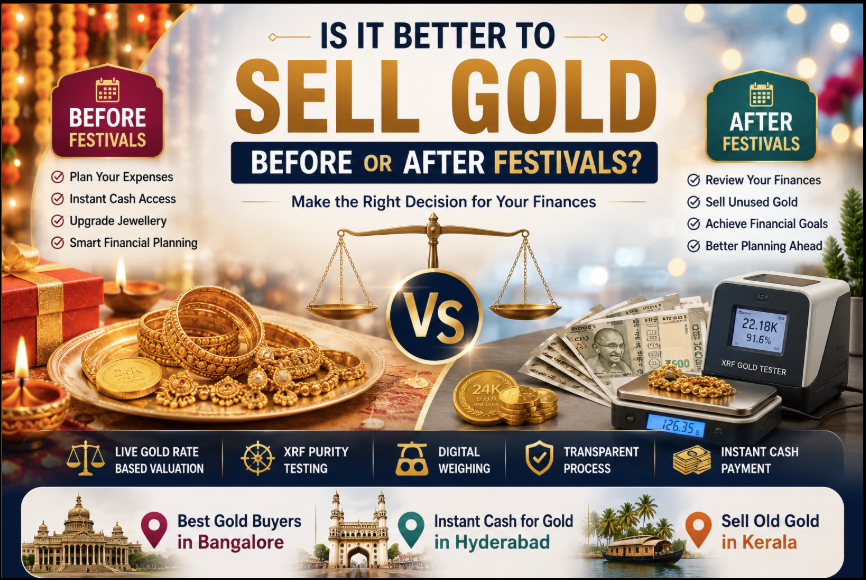
Is It Better to Sell Gold Before or After Festivals?

LIjo James
Festivals have always played an important role in India’s relationship with gold. Whether it’s Diwali, Akshaya Tritiya, Onam, Dussehra, Vishu, Pongal, Ugadi, Eid, Christmas, or the wedding season, gold often becomes part of family traditions, celebrations, and long-term financial planning. Many people buy new jewellery during these occasions, while others use the opportunity to sell old or unused gold to meet expenses or achieve personal financial goals.
If you’re planning to sell old jewellery, you may have wondered:
- Should I sell my gold before Diwali?
- Will I receive a better price after festivals?
- Do festivals actually affect gold prices?
- Is there a “best” time to sell old gold?
These are valid questions because gold prices often receive more attention during festive seasons. However, many people confuse higher consumer demand with higher resale value. While festivals can increase jewellery purchases, they do not automatically guarantee that sellers will receive better valuations simply because demand is higher.
In reality, professional gold buyers typically value gold based on measurable factors such as purity, weight, and the prevailing market gold rate, regardless of whether it’s festival season or an ordinary weekday. Understanding how this process works can help you make a more informed decision instead of relying on common assumptions.
If you’re considering selling your jewellery, it’s also worth understanding how transparent valuation practices work. Whether you’re looking for Best Gold Buyers in Bangalore, need Instant Cash for Gold in Hyderabad, or want to Sell Old Gold in Kerala, knowing what influences gold valuation is often more important than trying to predict the perfect time to sell.
In this guide, you’ll learn:
- How festivals influence India’s gold market
- Whether festive demand affects resale prices
- The advantages and considerations of selling before or after festivals
- How professional gold valuation works
- Common myths about festival gold selling
- Practical tips to help you make a confident, informed decision
By the end of this article, you’ll have a clearer understanding of when selling gold makes sense based on your financial goals, rather than seasonal assumptions.
Why Festivals Influence India’s Gold Market
India is one of the world’s largest consumers of gold, and festivals have long been associated with buying jewellery and precious metals. Gold is often viewed as a symbol of prosperity, celebration, and long-term value, making festive seasons a popular time for purchases.
However, it’s important to understand why demand increases and what that means for people planning to sell gold.
Gold Holds Cultural Significance
Across different regions of India, gold is deeply connected with traditions and family celebrations.
For example:
- Diwali is often associated with buying precious metals as a symbol of prosperity.
- Akshaya Tritiya is widely regarded as an auspicious day for purchasing gold.
- Onam and Vishu see increased jewellery purchases in Kerala.
- Dussehra and Ugadi encourage festive shopping in many states.
- Weddings throughout the year also contribute to strong jewellery demand.
These traditions help explain why jewellery stores often experience increased footfall during festive periods.
Increased Jewellery Purchases
Many families purchase:
- Gold necklaces
- Bangles
- Earrings
- Chains
- Coins
- Gifts for weddings
- Investment gold
Retailers often launch festive collections and promotional campaigns during these periods, which naturally attracts more buyers.
However, increased buying activity does not automatically mean resale prices increase by the same proportion.
Wedding Season Demand
India’s wedding season significantly contributes to gold purchases every year.
Families often buy jewellery for:
- Bridal collections
- Gifts
- Religious ceremonies
- Family investments
Because weddings frequently overlap with festival seasons, jewellery demand may appear even stronger during these months.
Retail Promotions
Festive periods are also known for:
- New jewellery collections
- Promotional offers
- Exchange schemes
- Customer events
- Extended shopping hours
These promotions are generally aimed at attracting buyers rather than changing the way old gold is valued.
Seasonal Buying Behaviour
Many consumers prefer purchasing gold during festivals because of tradition rather than market timing.
Similarly, some people choose to sell old jewellery before festivals to:
- Fund celebrations
- Upgrade jewellery
- Purchase new ornaments
- Meet seasonal expenses
These are personal financial decisions rather than indicators of guaranteed price advantages.
| Festival Market Activity | What It Means |
| Higher jewellery purchases | Increased retail demand |
| Wedding season | More consumer buying |
| Festival promotions | More shopping activity |
| Family celebrations | Higher spending |
| Consumer confidence | Increased market participation |
| Old gold selling | Often driven by personal financial needs |
Key Point: More people buying gold during festivals does not automatically increase the resale value of old jewellery.
Q. Why do festivals influence India’s gold market?
Festivals influence India’s gold market because many families traditionally purchase jewellery and gold coins during occasions such as Diwali, Akshaya Tritiya, Onam, and weddings. While these events increase retail demand, they do not automatically result in higher resale values for people selling old gold.
Key Takeaways
- Festivals encourage more people to buy gold.
- Wedding seasons also contribute to higher jewellery demand.
- Retail promotions are aimed primarily at buyers.
- Increased demand does not guarantee higher resale prices.
- Personal financial goals remain more important than seasonal trends when deciding to sell gold.
Do Festivals Actually Affect Gold Prices?
One of the most common misconceptions is that gold prices always rise during festivals. While festivals often increase jewellery purchases, the factors influencing gold prices are far more complex.
Gold is traded in global markets, and its price reflects a combination of international and domestic economic conditions. This means that festive demand is only one of many influences—and not always the most significant.
Global Factors That Influence Gold Prices
International Gold Prices
Gold is traded worldwide, and international market movements often influence domestic prices. Changes in global demand, investor sentiment, and economic conditions can all contribute to price fluctuations.
Inflation
Gold is sometimes viewed as a store of value during periods of inflation. Changes in inflation expectations can affect demand for gold in international markets, which may influence local prices.
Currency Movements
Because gold is traded globally, exchange rate movements can affect domestic pricing. Changes in currency values may contribute to day-to-day fluctuations in the local gold rate.
Central Bank Activity
Central banks around the world buy and hold gold as part of their reserves. Their buying or selling activity can influence overall market sentiment and, in turn, gold prices.
Domestic Factors
Festival Demand
Demand often rises during major festivals as more people purchase jewellery and gold coins. However, retail buying alone does not determine market prices.
Wedding Season
India’s wedding season can increase jewellery purchases, adding to overall consumer demand. This is one of several domestic influences on the gold market.
Consumer Buying Trends
Economic confidence, disposable income, and household spending patterns can all affect how much gold people choose to buy during different times of the year.
Market Sentiment
Public perception of the economy and broader financial conditions can influence gold buying and selling behaviour. These factors often interact with global market movements.
Q. Can Anyone Predict Short-Term Gold Prices?
The simple answer is no.
While analysts may discuss market trends, no one can accurately predict short-term gold prices with certainty. Prices are influenced by a combination of global events, economic indicators, currency movements, and investor behaviour—many of which can change rapidly.
For this reason, trying to time the market perfectly is often less practical than focusing on your own financial needs and ensuring a transparent valuation process.
Q. Do festivals affect gold prices?
Festivals can increase consumer demand for gold jewellery and coins, but they are only one of many factors influencing gold prices. International market trends, inflation, currency movements, and economic conditions typically have a greater impact on the prevailing gold rate.
Key Takeaways
- Gold prices are influenced by multiple global and domestic factors.
- Festival demand alone does not determine resale prices.
- Short-term price movements cannot be predicted with certainty.
- Understanding the valuation process is often more valuable than trying to time the market.
- Personal financial goals should guide your selling decision more than seasonal assumptions.
Selling Gold Before Festivals
Many people choose to sell old gold in the weeks leading up to major festivals. This decision is often driven by personal financial planning rather than an expectation that gold will automatically fetch a higher resale value.
Whether you’re preparing for Diwali, Onam, Dussehra, Akshaya Tritiya, Vishu, Pongal, Ugadi, Eid, or the wedding season, selling before a festival can make sense if it aligns with your immediate financial needs.
The important thing to remember is that the “best” time to sell isn’t determined by the calendar alone—it depends on your circumstances, the prevailing gold rate, and the transparency of the valuation process.
Why Some People Sell Gold Before Festivals
1. Managing Festival Expenses
Festivals often involve additional spending on:
- Home decorations
- Clothing
- Gifts
- Travel
- Family gatherings
- Religious ceremonies
Some households choose to sell unused or broken jewellery to help cover these seasonal expenses rather than relying on loans or credit.
2. Upgrading Old Jewellery
Many families exchange outdated or damaged jewellery for newer designs during festive shopping.
Selling old pieces beforehand can provide funds for:
- New ornaments
- Bridal jewellery
- Investment gold coins
- Family gifts
3. Immediate Access to Funds
If someone needs money for:
- School fees
- Medical expenses
- Business payments
- Home repairs
- Festival shopping
selling unused gold can provide immediate liquidity without creating future repayment obligations.
4. Taking Advantage of Current Market Conditions
Some sellers monitor the live gold rate and decide to sell when they feel the price meets their expectations.
Rather than waiting for a festival, they focus on today’s market value and their personal financial goals.
Things to Consider Before Selling
| Potential Benefits | Things to Consider |
| Immediate cash availability | Gold prices fluctuate daily |
| Helps fund festival expenses | Compare multiple buyers first |
| Useful for unused jewellery | Understand valuation methods |
| No loan repayment | Avoid emotional decisions |
| Can simplify financial planning | Review deductions carefully |
Q. Should I sell gold before Diwali?
Selling gold before Diwali may be suitable if you need funds for festival expenses or have unused jewellery to sell. However, the decision should be based on your financial goals, current market rates, and transparent valuation rather than assuming festival demand guarantees a higher resale price.
Key Takeaways
- Selling before festivals can help meet short-term financial needs.
- It is useful for people upgrading jewellery or funding celebrations.
- Compare valuation methods before accepting an offer.
- Festivals alone do not determine resale value.
Selling Gold After Festivals
Not everyone chooses to sell before a festival. Some people prefer to wait until celebrations are over so they can evaluate their financial situation more clearly.
This can also be a practical choice, but waiting does not guarantee a higher or lower valuation.
Does Waiting Guarantee Better Prices?
No.
Gold prices move according to many global and domestic factors.
Waiting until after a festival does not automatically result in:
- Higher gold prices
- Better resale value
- Larger payouts
Likewise, selling before a festival doesn’t guarantee a lower valuation.
| Selling Before Festivals | Selling After Festivals |
| Useful for festival expenses | Useful for post-festival budgeting |
| Helps fund celebrations | Helps manage new financial goals |
| Immediate liquidity | Allows more planning time |
| Depends on current gold rate | Also depends on current gold rate |
| Personal decision | Personal decision |
Q. Should I sell gold after festivals?
Selling gold after festivals can be a practical choice if you’re reviewing your finances or no longer need certain jewellery. However, waiting until after a festival does not guarantee a better resale price, as valuations depend primarily on purity, weight, and current market rates.
Key Takeaways
- Many people sell after festivals for budgeting reasons.
- Waiting does not guarantee higher resale value.
- Personal financial priorities should guide the timing.
Q. Does XRF testing change during festivals?
No. XRF testing follows the same process throughout the year. It is used to measure the purity of gold accurately without damaging the jewellery, regardless of whether the valuation takes place during a festival or on any other day.
Key Takeaways
- Festival seasons do not change the way gold purity is tested.
- Professional valuation is based on measurable factors.
- Transparency matters more than timing.
- Understanding the valuation process helps sellers make informed decisions.
Selling Before vs After Festivals
| Factor | Before Festivals | After Festivals |
| Festival expenses | ✓ Common reason | Less common |
| Budget review | Limited | ✓ Common reason |
| Emergency cash | ✓ Yes | ✓ Yes |
| Jewellery upgrade | ✓ Common | Possible |
| Better valuation guaranteed? | ✗ No | ✗ No |
| Based on live gold rate | ✓ Yes | ✓ Yes |
Gold Valuation Factors
| Valuation Factor | Does Festival Season Change It? |
| Gold Purity | No |
| XRF Testing | No |
| Digital Weight | No |
| Live Gold Rate | Changes with the market, not simply because of festivals |
| Documentation | No |
| Payment Process | Usually follows the same procedures |
Common Myths About Selling Gold During Festivals
Many beliefs about festival gold selling are based on assumptions rather than facts.
Let’s look at some common myths.
Myth 1: Gold Always Sells for More During Festivals
Reality:
Festivals often increase jewellery purchases, but resale valuation still depends on:
- Purity
- Weight
- Current market gold rate
- Transparent valuation methods
Higher retail demand does not automatically increase the resale value of old gold.
Myth 2: Every Gold Buyer Offers the Same Valuation
Reality:
Different buyers may follow different valuation processes.
Before selling, understand:
- Which gold rate is being used
- How purity is tested
- Whether deductions are clearly explained
- How the final value is calculated
Transparency is just as important as the quoted amount.
Myth 3: You Should Never Sell Before Diwali
Reality:
There is no universal rule.
Selling before Diwali may be appropriate if it aligns with your financial goals or if you need funds for upcoming expenses.
Myth 4: You Must Wait Until Akshaya Tritiya
Reality:
Akshaya Tritiya is traditionally associated with buying gold, but there is no guarantee that waiting until or after this festival will result in a better resale valuation.
Myth 5: Festival Offers Always Mean Better Resale Value
Reality:
Retail promotional campaigns are generally designed for new jewellery purchases.
They do not necessarily affect how professional buyers calculate the value of old gold.
Myth vs Fact Table
| Myth | Fact |
| Gold always sells for more during festivals | Valuation depends on purity, weight, and market rate |
| Every buyer offers the same value | Valuation methods and transparency can differ |
| Never sell before Diwali | Timing depends on personal financial goals |
| Wait for Akshaya Tritiya | No guarantee of a better resale value |
| Festival promotions improve resale | Retail offers don’t automatically change valuation |
Q. Does festive demand increase gold resale value?
Festive demand may increase jewellery purchases, but it does not automatically increase the resale value of old gold. Professional buyers generally calculate valuations based on purity, weight, and the prevailing market gold rate rather than the festival calendar.
Key Takeaways
- Separate myths from measurable valuation factors.
- Don’t rely solely on seasonal assumptions.
- Focus on transparency, purity testing, and your financial needs.
- Make decisions based on facts rather than common misconceptions.
Final Thoughts
Whether you choose to sell your gold before or after festivals, the most important factor is making a decision that supports your personal financial needs—not trying to predict short-term market movements.
Festivals such as Diwali, Onam, Akshaya Tritiya, Dussehra, Vishu, Pongal, Ugadi, Eid, and the wedding season often increase gold-buying activity across India, but they do not automatically determine the resale value of old gold. Professional valuation is typically based on measurable factors such as purity, weight, and the prevailing market gold rate.
If you’re planning to sell old jewellery, gold coins, inherited ornaments, or broken gold, take time to understand how the valuation works, compare transparent buyers, ask questions about the testing process, and review today’s live gold rate before making a decision.
Ultimately, the best time to sell is when it aligns with your financial priorities and you’re confident that you understand the valuation process.
If you’d like to learn more about transparent gold selling, XRF purity testing, and the selling process in your region, explore our location-specific resources:
- Best Gold Buyers in Bangalore – Learn about transparent valuation methods, required documents, and what to look for when choosing a professional gold buyer in Bangalore.
- Instant Cash for Gold in Hyderabad – Discover the step-by-step gold selling process, XRF purity testing, and same-day payment practices followed by organised gold buyers in Hyderabad.
- Sell Old Gold in Kerala – Understand how to prepare for selling old gold, compare valuation methods, and make informed decisions before visiting a gold buyer in Kerala.
Frequently Asked Questions
1. Is it better to sell gold before or after festivals?
There isn’t a single “best” time that applies to everyone. The right time depends on your financial goals, the current market gold rate, and whether the jewellery is still useful to you. Festivals may influence buying activity, but they do not automatically determine the resale value of your gold.
2. Do festivals affect gold prices?
Festival seasons can increase consumer demand for gold jewellery, but gold prices are also influenced by international market movements, currency fluctuations, inflation, and other economic factors. Because multiple factors affect prices, no one can accurately predict short-term price movements.
3. Does festive demand increase the resale value of old gold?
Not necessarily. Professional gold buyers generally value old gold based on its purity, weight, and the prevailing market gold rate rather than the festival season itself.
4. Should I wait until after Diwali to sell my gold?
Waiting until after Diwali does not guarantee a higher valuation. If you need funds immediately or have unused jewellery, it may be more practical to sell when it aligns with your financial needs rather than waiting for a specific festival.
5. Can I sell broken jewellery during festivals?
Yes. Broken jewellery is generally valued based on the recoverable gold content, regardless of whether it is sold during a festival or at another time of the year.
6. Is XRF gold testing available during festive seasons?
Yes. Professional buyers that use XRF technology typically follow the same purity testing process throughout the year. The method does not change because of festivals.