
-
By LIjo James
-
June 26, 2026
- 0 Comment
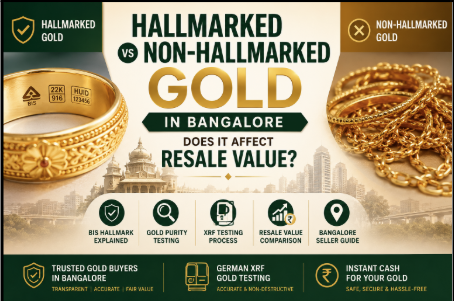
Hallmarked vs Non-Hallmarked Gold in Bangalore

LIjo James
Lijo James – Internal Auditor & Gold Appraiser With over 10 years of experience, Lijo James is a seasoned Internal Auditor and Gold Appraiser specializing in the gold market. His expertise lies in conducting detailed gold market studies, ensuring accurate appraisals, and implementing robust auditing practices. Lijo’s in-depth knowledge of gold trends and market dynamics enables him to deliver reliable insights and maintain high standards of financial accountability. Dedicated to precision and integrity, he consistently ensures compliance with industry regulations while optimizing processes. His commitment to excellence makes him a trusted professional in the gold appraisal and auditing sector.
Read full bio of LIjo JamesWhen people plan to sell old jewellery, one of the most common questions they ask is:
“Does hallmarked gold get a better price than non-hallmarked gold?”
This question is especially common among families in Bangalore who own a mix of modern BIS hallmarked jewellery, inherited ornaments, old wedding jewellery, gold coins, and jewellery purchased decades ago.
Many sellers assume that non-hallmarked gold has little value or that hallmarked jewellery automatically receives a much higher resale price.
The reality is more nuanced.
While hallmarking improves confidence and transparency, the actual resale value of gold is primarily determined by:
- Gold purity
- Net gold weight
- Current market gold rates
- Valuation process
This means that both hallmarked and non-hallmarked gold can have significant resale value when properly tested and evaluated.
Whether you’re planning to sell old jewellery, inherited ornaments, gold coins, or pledged jewellery, understanding the difference between hallmarked and non-hallmarked gold can help you make a better decision.
For many customers visiting Gold Buyers in Bangalore, this knowledge helps them understand why purity testing and valuation are more important than simply looking for a hallmark stamp.
What Is Hallmarked Gold?
Hallmarked gold is gold jewellery that has been tested and certified for purity through the Bureau of Indian Standards (BIS) hallmarking system. The hallmark confirms that the jewellery meets specific purity standards and provides buyers with greater confidence regarding the gold’s authenticity and quality.
Hallmarking was introduced to protect consumers from purchasing gold with incorrect purity claims.
Today, BIS hallmarking is one of the most trusted methods of gold purity certification in India.
When jewellery is hallmarked, it undergoes testing through authorized hallmarking centres before being certified.
The hallmark helps consumers know whether the gold purity matches the seller’s claim.
Components of BIS Hallmark Gold
Modern BIS hallmarked jewellery generally includes:
Component | Meaning |
BIS Logo | Certification by BIS |
Purity Mark | Gold purity level |
HUID Number | Unique identification code |
Jeweller Identification | Registered seller identification |
Common Hallmark Purity Levels
Gold Purity | Purity Percentage |
24K | 99.90% |
22K | 91.60% |
18K | 75% |
14K | 58.50% |
The purity level directly affects resale value because higher-purity gold contains more actual gold content.
What Is HUID?
HUID stands for:
Hallmark Unique Identification Number
Every hallmarked jewellery item receives a unique alphanumeric code.
This code helps improve traceability and strengthens confidence in purity claims.
Many customers searching:
- how to identify hallmarked gold
- how to check BIS hallmark gold
are often referring to this unique hallmark identification system.
What Is Non-Hallmarked Gold?
Non-hallmarked gold refers to jewellery that does not carry BIS hallmark certification.
This does not automatically mean the gold is fake or low quality.
In fact, a large amount of jewellery owned by Indian families today is non-hallmarked.
Common Examples of Non-Hallmarked Gold
Older Wedding Jewellery
Many Bangalore families own wedding jewellery purchased before hallmarking became widespread.
These ornaments may still contain high-purity gold.
Inherited Jewellery
Family heirlooms passed through generations often do not have BIS hallmark markings.
However, many still contain valuable gold content.
Traditional Jewellery
Older handcrafted jewellery was frequently produced before mandatory hallmarking practices became common.
Gold Purchased Decades Ago
Many ornaments bought 20–30 years ago have no hallmark but may still possess substantial resale value.
Practical Bangalore Example
A family from Jayanagar recently brought inherited jewellery for valuation.
None of the ornaments were hallmarked.
Initially, the family believed the jewellery would receive a lower valuation because of the missing hallmark.
However, German XRF testing revealed that several pieces contained high-purity gold.
The final valuation was based on actual purity and weight rather than the presence or absence of a hallmark.
This is a common scenario among customers visiting Old Gold Buyers in Bangalore.
Hallmarked vs Non-Hallmarked Gold: Key Differences
Factor | Hallmarked Gold | Non-Hallmarked Gold |
Purity Verification | BIS Certified | Requires Testing |
Buyer Confidence | Higher | Depends on Testing |
Resale Process | Often Faster | Requires Additional Verification |
Documentation | Usually Available | May Be Limited |
Transparency | Higher | Depends on Testing Process |
Purity Confirmation | Easier | Must Be Verified |
Risk of Purity Uncertainty | Lower | Higher |
Does Hallmarked Gold Have Better Resale Value?
This is where many gold sellers become confused.
Hallmarking itself does not increase the amount of gold present in the jewellery.
The actual resale value depends primarily on:
- Gold purity
- Gold weight
- Current gold rate
- Valuation process
Why Hallmarked Gold Often Appears More Valuable
Hallmarked jewellery often enjoys:
Faster Verification
The hallmark provides an initial purity reference.
Better Buyer Confidence
Buyers feel more comfortable evaluating jewellery with certified purity markings.
Reduced Purity Uncertainty
The valuation process may require fewer additional checks.
Smoother Transactions
The overall resale process can be faster and more transparent.
Important Reality
A non-hallmarked 22K gold chain containing genuine 22K purity can receive a valuation very similar to a hallmarked 22K chain if testing confirms the same purity level.
This is why professional Gold Buyers in Bangalore rely heavily on purity testing rather than visual assumptions.
Can Non-Hallmarked Gold Be Sold?
Yes. Non-hallmarked gold can be sold. Professional gold buyers use purity testing methods such as German XRF testing to determine actual gold content. The resale value is based on purity, weight, and current gold rates rather than the presence of a hallmark alone.
Many people mistakenly believe:
“Without a hallmark, nobody will buy my jewellery.”
This is not true.
Professional buyers regularly evaluate:
- Old family jewellery
- Inherited ornaments
- Traditional jewellery
- Broken gold jewellery
- Non-hallmarked gold coins
The key requirement is accurate purity verification.
Common Concerns About Selling Non-Hallmarked Gold
Is it Legal?
Yes, selling non-hallmarked gold is legal when ownership and identification requirements are satisfied.
Will Buyers Reject It?
Most professional buyers will not reject non-hallmarked gold solely because it lacks a hallmark.
Will I Get Less Value?
Not necessarily.
Actual purity matters more than hallmark presence.
How Is Purity Verified?
Through scientific testing methods such as German XRF Gold Testing.
Why Purity Testing Matters More Than Hallmarking
A hallmark is useful.
But it is still a mark placed on jewellery at a particular point in time.
Professional buyers often verify purity independently before final valuation.
This ensures transparency for both parties.
As a result, modern gold valuation depends heavily on testing technology rather than visual inspection alone.
How Gold Buyers Verify Gold Purity
Whether jewellery is hallmarked or non-hallmarked, professional gold buyers typically verify purity before providing a final valuation.
This is because gold purity directly affects resale value.
A small difference in purity can significantly impact the amount a seller receives.
For example:
- A 22K ornament contains approximately 91.6% pure gold.
- An 18K ornament contains approximately 75% pure gold.
Even if both pieces weigh the same, their resale values will be different.
German XRF Gold Testing
Modern gold buyers often use German XRF (X-Ray Fluorescence) technology to evaluate gold purity.
Benefits of XRF Testing
✔ Non-destructive
✔ No damage to jewellery
✔ Instant results
✔ High accuracy
✔ Transparent valuation
XRF testing identifies the composition of metals within the jewellery and helps determine the actual gold percentage.
This is why many sellers searching for:
- How gold buyers verify gold purity
- Gold valuation process Bangalore
- Hallmarked gold resale value in Bangalore
often encounter references to XRF testing.
Hallmark Verification
If jewellery carries a BIS hallmark, buyers may verify:
- Hallmark stamp
- Purity mark
- HUID number
- BIS certification indicators
However, most professional buyers still perform purity testing before final valuation.
Weight Analysis
The jewellery is weighed using calibrated digital scales.
If stones, beads, or decorative elements are attached, their weight may be excluded from the gold calculation.
Purity Assessment
Once purity and net gold weight are confirmed, the valuation is calculated using current market rates.
XRF Testing vs Acid Testing
Many sellers are unfamiliar with the difference between these two methods.
Method | Transparency | Accuracy | Jewellery Damage |
German XRF Testing | High | High | None |
Acid Testing | Moderate | Moderate | Minor Surface Contact Possible |
Why XRF Testing Is Preferred
Professional buyers increasingly prefer XRF testing because:
- Results are instant
- No scraping is required
- Customers can observe the process
- Purity analysis is more detailed
For sellers comparing valuation methods, understanding XRF Gold Testing vs Acid Testing can improve confidence in the process.
How Purity Affects Gold Resale Value
One of the biggest misconceptions among gold sellers is that hallmarking alone determines resale value.
In reality:
Purity + Weight = Primary Drivers of Value
Whether the jewellery is hallmarked or non-hallmarked, its resale value is largely based on:
- Actual gold content
- Net weight
- Current market gold rate
Example 1: 22K Hallmarked Chain
- Weight
50 grams
- Purity
22K
- Gold Content
Approximately 45.8 grams of pure gold
Because of the high purity level, the valuation remains strong.
Example 2: 18K Hallmarked Jewellery
- Weight
50 grams
- Purity
18K
- Gold Content
Approximately 37.5 grams of pure gold
Although hallmarked, the lower purity reduces overall resale value compared to a 22K piece of the same weight.
Example 3: Non-Hallmarked 22K Jewellery
- Weight
50 grams
- Purity Verified Through XRF
22K
- Gold Content
Approximately 45.8 grams
In this case, the non-hallmarked jewellery may receive a valuation similar to the hallmarked piece because the actual purity is the same.
This illustrates why purity matters more than the hallmark itself.
Hallmarked Gold Resale Value in Bangalore
Many customers specifically search for:
- Hallmarked gold resale value in Bangalore
- Is hallmarked gold worth more when selling?
- Does the BIS hallmark increase gold value?
The answer requires understanding how buyers calculate value.
What Hallmarking Improves
Hallmarking improves:
- Transparency
The buyer has greater confidence regarding purity claims.
- Verification Speed
Initial purity identification becomes easier.
- Customer Confidence
The seller has supporting evidence regarding gold quality.
- Reduced Disputes
Purity discussions become simpler.
Real Bangalore Examples
The following examples illustrate how hallmarking affects the selling experience.
1.Whitefield Family with Hallmarked Jewellery
Situation
A family from Prestige Shantiniketan wanted to sell wedding jewellery purchased recently.
Challenge
They wanted assurance that the valuation reflected current market value.
Testing Process
- Hallmark verification
- XRF testing
- Weight analysis
Outcome
The hallmark helped establish confidence, while XRF testing confirmed purity for valuation.
1.Jayanagar Family with Inherited Jewellery
Situation
The jewellery had been passed down through generations.
Challenge
No hallmark and no original purchase records.
Testing Process
- XRF purity analysis
- Weight verification
- Gold content calculation
Outcome
The family discovered that the jewellery contained high-purity gold despite lacking hallmark certification.
1.Koramangala Professional Selling Gold Coins
Situation
A working professional wanted to liquidate investment gold coins.
Challenge
Understanding whether hallmarking influenced value.
Testing Process
- Purity verification
- Weight analysis
- Market rate calculation
Outcome
The valuation was primarily influenced by purity and weight.
3. Electronic City Seller Without Hallmark
Situation
An IT employee owned older family jewellery.
Challenge
Concern that non-hallmarked jewellery would receive a poor valuation.
Testing Process
- German XRF testing
- Purity assessment
- Net weight calculation
Outcome
The jewellery achieved a valuation based on its actual gold content rather than the absence of a hallmark.
Why Hallmarked Gold Often Creates More Confidence
Although purity ultimately determines value, hallmarked gold often makes the selling process smoother.
Easier Verification
The hallmark provides an initial reference point regarding purity.
Faster Valuation
Buyers can begin the evaluation process with additional confidence.
Reduced Purity Disputes
Hallmarking lowers uncertainty regarding quality claims.
Better Transparency
Both buyer and seller have access to standardized purity information.
Improved Consumer Trust
Many first-time sellers feel more comfortable selling hallmarked jewellery because the purity has already been certified.
However, it is important to remember:
Hallmarking Creates Confidence
Purity Creates Value
This distinction helps explain why non-hallmarked gold can still receive strong valuations when purity testing confirms high gold content.
Common Myths About Hallmarked and Non-Hallmarked Gold
When selling old jewellery, many Bangalore sellers rely on assumptions rather than facts. This often leads to confusion about gold purity, hallmarking, and resale value.
Let’s separate myths from reality.
Myth 1: Non-Hallmarked Gold Has No Value
Reality
This is one of the most common misconceptions.
Non-hallmarked gold can still have significant resale value if purity testing confirms good gold content.
Many inherited ornaments, traditional jewellery, and family heirlooms were purchased before hallmarking became common.
Professional Gold Buyers in Bangalore regularly evaluate non-hallmarked jewellery through German XRF testing.
Myth 2: Hallmarked Gold Always Gets a Higher Price
Reality
Hallmarking itself does not increase gold content.
If a hallmarked and non-hallmarked ornament have identical purity and weight, their valuation may be very similar after testing.
The hallmark creates confidence, but purity determines value.
Myth 3: Old Jewellery Cannot Be Sold
Reality
Many Bangalore families successfully sell:
- Old wedding jewellery
- Inherited ornaments
- Broken jewellery
- Traditional gold pieces
- Non-hallmarked jewellery
The key factor is purity verification.
Myth 4: Hallmark Replaces Purity Testing
Reality
Even hallmarked jewellery is often tested before final valuation.
Professional buyers use XRF testing to verify current purity levels before making an offer.
Myth 5: Broken Jewellery Has Lower Gold Value
Reality
Gold value is based primarily on:
- Purity
- Weight
- Current gold rate
The physical appearance of the jewellery usually has little impact on gold content valuation.
How to Get the Best Resale Value for Gold in Bangalore
Whether your jewellery is hallmarked or non-hallmarked, a few practical steps can help maximize resale value.
Verify Purity Before Selling
The first step is understanding the actual purity of your jewellery.
Professional testing helps eliminate uncertainty and improves transparency.
Compare Multiple Valuations
Do not accept the first offer immediately.
Comparing multiple valuations helps you understand:
- Market value
- Purity assumptions
- Deductions
- Overall transparency
Check Today’s Gold Rate
Before visiting a buyer, review:
Gold Rate Today in Bangalore
This provides a benchmark for understanding the valuation process.
Ask for German XRF Testing
XRF testing is one of the most reliable methods for purity verification.
Benefits include:
✔ Accurate results
✔ Non-destructive process
✔ Transparent valuation
✔ Faster assessment
Keep Available Documentation
Although jewellery can often be sold without a bill, maintaining available records can simplify the process.
For more information, read:
Sell Gold Without a Bill in Bangalore
Understand Gold Rate vs Selling Rate
Many sellers assume the market gold rate and selling rate are identical.
To understand the difference, see:
Gold Rate vs Selling Rate in Bangalore
Conclusion
The debate around Hallmarked vs Non-Hallmarked Gold often creates confusion among sellers.
The most important takeaway is:
Hallmarking Improves Confidence
Purity Determines Value
Hallmarked jewellery often creates a smoother selling experience because purity certification is already available. However, non-hallmarked gold can still receive excellent valuations when professional testing confirms high gold content.
For sellers in Bangalore:
- Verify purity through German XRF testing
- Compare multiple valuations
- Check current gold rates
- Understand deductions
- Choose transparent Gold Buyers in Bangalore
Making informed decisions can help you maximize value while ensuring a safe and transparent selling experience.
Frequently Asked Questions On Hallmarked VS Non-Hallmarked Gold
1. What is hallmarked gold?
Hallmarked gold is jewellery certified for purity through the BIS hallmarking system.
2. What is non-hallmarked gold?
Non-hallmarked gold is jewellery without BIS purity certification.
3. Can non-hallmarked gold be sold?
Yes. Professional buyers can evaluate non-hallmarked gold through purity testing.
4. Does hallmarked gold have better resale value?
Hallmarking improves confidence and transparency, but actual resale value depends mainly on purity and weight.
5. Does the BIS hallmark increase gold value?
BIS hallmarking itself does not increase gold content or weight. It certifies purity.
6. How can I identify hallmarked gold?
Look for:
- BIS logo
- Purity mark
- HUID number
- Jeweller identification
7. Is hallmarked gold always genuine?
Hallmarked jewellery generally provides greater confidence, but professional buyers may still verify purity through testing.
8. Can I sell non-hallmarked inherited jewellery?
Yes. Many inherited ornaments are evaluated successfully through purity testing.
9. What is hallmarked gold resale value in Bangalore?
Resale value depends on purity, weight, and current market gold rates.
10. Who are the best hallmarked gold buyers in Bangalore?
The best buyers typically offer transparent purity testing, live gold rates, clear valuation explanations, and secure payment processes.
11. Is non-hallmarked gold fake?
No. Many genuine gold ornaments were purchased before hallmarking became widespread.
12. Is hallmarked gold easier to sell?
Generally yes, because purity certification creates greater confidence.
Popular Branches – Best Gold Buyers in Bangalore | Best Gold Buyers in Hyderabad | Gold Buyers in Kerala | Best Gold Buying Company in Calicut | Gold Buyers in Malappuram Online | Best Gold Buyers in Ernakulam | Best Gold Buyers in Kochi | Gold Buyers in Irinjalakuda | Gold Buyers in Kannur | Gold Buyers in Thrissur
Written by LIjo James