
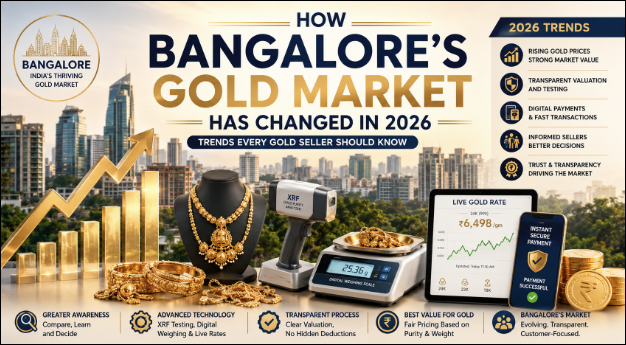
How Bangalore’s Gold Market Has Changed in 2026

LIjo James
Table of Contents
- Overview of Bangalore’s Gold Market in 2026
- Key Factors Driving the Gold Market
- Why More Bangalore Residents Are Selling Old Gold
- How Technology Has Changed Gold Valuation
- Modern Gold Buyers vs Traditional Jewellery Stores
- How Consumer Expectations Have Changed
- Gold Price Trends and Their Impact on Sellers
- Is 2026 a Good Time to Sell Gold?
- Practical Tips Before Selling Gold in Bangalore
- Future Outlook for Bangalore’s Gold Market
- Frequently Asked Questions
- Conclusion
Bangalore has long been one of India’s fastest-growing metropolitan cities, known for its thriving technology sector, diverse population, and strong consumer spending. Alongside these developments, the city has also become an important market for buying, selling, and investing in gold. Whether it’s traditional jewellery purchased during weddings, inherited family ornaments, or modern gold coins, gold continues to hold both cultural and financial significance for Bangalore residents.
In 2026, Bangalore’s gold market is experiencing notable changes driven by evolving consumer expectations, advances in valuation technology, and greater awareness about transparent gold-selling practices. More people are researching current gold prices in Bangalore, comparing valuation methods, and seeking organised gold buying companies that clearly explain how the value of their jewellery is calculated.
Another major shift is the increasing use of digital tools throughout the gold-selling process. Modern purity testing methods, digital weighing systems, live market rate integration, and electronic payment options have made transactions more transparent and convenient than ever before. Customers today are more informed and expect businesses to provide accurate valuations, detailed explanations, and professional service.
Economic factors have also influenced consumer behaviour. Rising gold prices over recent years have encouraged many homeowners, working professionals, retirees, and families to reassess jewellery that has remained unused for years. Instead of keeping broken ornaments or outdated designs locked away, many people are evaluating whether selling them aligns with their financial goals.
At the same time, the gold-buying industry itself has become more organised. Professional Gold Buyers in Bangalore increasingly use non-destructive testing technologies, digital documentation, and transparent valuation processes that help customers better understand how offers are determined.
However, despite these improvements, many sellers still have important questions:
- How has Bangalore’s gold market changed in 2026?
- Why are more people selling old jewellery now?
- What factors influence gold prices?
- How has technology improved gold valuation?
- Is 2026 a suitable time to sell gold?
- What should you know before visiting a gold buyer?
This comprehensive guide answers these questions using current industry practices and publicly available market insights. You’ll learn how Bangalore’s gold market has evolved, what trends are shaping the industry, and the practical steps you can take to make informed decisions before selling your gold.
Overview of Bangalore’s Gold Market in 2026
Bangalore has always been an important destination for gold jewellery, not only because of its large urban population but also due to its strong purchasing power and vibrant retail ecosystem. In 2026, the city’s gold market continues to evolve as both buyers and sellers adapt to changing economic conditions and customer expectations.
Unlike a decade ago, today’s market is no longer dominated solely by traditional jewellery stores. Professional gold buying companies, digital valuation services, and specialised old gold buyers have become increasingly visible across the city. This has expanded the options available to customers looking to sell old, broken, inherited, or unused jewellery.
Several developments have contributed to this transformation.
Greater Consumer Awareness
Today’s gold sellers are better informed than ever before. Before visiting a buyer, many people now:
- Check live gold rates online.
- Read customer reviews.
- Compare valuation methods.
- Learn about purity testing.
- Understand documentation requirements.
This increased awareness has encouraged businesses to become more transparent in their valuation processes.
Growth of Organised Gold Buying Companies
The rise of organised gold buying companies has introduced greater standardisation into the industry. Many of these businesses focus exclusively on purchasing gold rather than selling jewellery, allowing them to streamline valuation and payment processes.
Customers increasingly expect:
- Transparent pricing
- Professional testing methods
- Digital documentation
- Clear explanations of deductions
- Same-day payment options
As a result, organised gold buyers have become an important part of Bangalore’s evolving gold ecosystem.
Shift Toward Professional Gold Valuation
Earlier, many sellers relied solely on local jewellers for valuation. Today, there is greater awareness that different businesses may follow different valuation methods.
Professional gold buyers often use modern technologies such as:
- German XRF purity testing
- Digital weighing machines
- Live market rate integration
- Computer-generated valuation reports
These practices help customers better understand how the value of their jewellery is calculated and reduce uncertainty during the selling process.
Increased Focus on Transparency
One of the biggest changes in Bangalore’s gold market is the growing importance of transparency.
Customers increasingly want answers to questions such as:
- How was the purity measured?
- What is today’s live gold rate?
- How was the final amount calculated?
- Are any deductions being applied?
- What documents are required?
Businesses that clearly explain these steps help customers make more informed decisions.
Changing Consumer Priorities
Modern consumers are not simply looking for the highest possible offer. Many also value:
- Trust
- Transparency
- Speed
- Convenience
- Professional service
- Secure digital payments
- Accurate purity testing
This shift has encouraged many businesses to improve their overall customer experience.
Key Takeaways
- Bangalore continues to be one of India’s major gold markets.
- Consumer awareness has increased significantly in 2026.
- Organised gold buying companies are becoming more common.
- Transparent valuation processes are now a major expectation.
- Technology is improving both accuracy and customer confidence.
Key Factors Driving Bangalore’s Gold Market in 2026
The gold market does not operate in isolation. A combination of global and domestic factors influences gold prices, consumer behaviour, and selling activity.
Understanding these factors can help sellers make more informed decisions rather than reacting solely to short-term price movements.
Global Factors
1. International Gold Prices
Gold is traded globally, meaning international market trends often influence local prices in India.
When global demand rises due to economic uncertainty or increased investment in precious metals, domestic gold prices may also respond. Conversely, changes in global sentiment can contribute to price fluctuations.
2. Inflation
Gold has traditionally been viewed by many investors as a store of value during periods of inflation.
When inflation affects purchasing power, interest in gold may increase, influencing demand and, in turn, market prices. While gold does not always move in direct proportion to inflation, inflation remains one of several important factors affecting the broader market.
3. Currency Fluctuations
International gold is generally priced in U.S. dollars. As a result, movements in exchange rates can influence domestic gold prices.
Changes in currency values may affect the cost of imported gold, which can have an indirect impact on local pricing.
4. Central Bank Activity
Central banks around the world sometimes adjust their gold reserves as part of broader monetary and reserve management strategies.
These activities can influence global market sentiment and contribute to broader trends in gold demand.
5. Economic Uncertainty
During periods of geopolitical tension, financial market volatility, or economic uncertainty, many investors pay closer attention to gold as part of their overall investment strategy.
This increased interest can influence global demand and contribute to changes in market prices.
Domestic Factors
While international developments are important, several India-specific factors also influence Bangalore’s gold market.
Wedding Season Demand
India’s wedding season has traditionally been associated with higher demand for gold jewellery.
Increased purchasing activity during these periods can affect overall market dynamics and consumer behaviour.
Festival Purchases
Festivals such as:
- Akshaya Tritiya
- Dhanteras
- Deepavali
- Ugadi
- Regional celebrations
often see increased interest in gold purchases. Seasonal demand can influence market activity, even though daily prices continue to depend on multiple domestic and international factors.
Consumer Spending Patterns
Economic confidence, employment trends, and disposable income influence how people buy, hold, or sell gold.
For example, households with changing financial priorities may decide to:
- Sell unused jewellery.
- Redeploy funds toward education or business.
- Invest in other financial assets.
- Upgrade older jewellery designs.
Regulatory and Policy Environment
Government regulations, taxation policies, import duties, and financial regulations can affect the overall gold ecosystem.
While individual sellers may not notice immediate changes, these factors influence the broader supply chain and market conditions over time.
Rising Awareness of Gold’s Financial Value
An important trend in 2026 is that more people are viewing unused jewellery not just as an emotional asset but also as a financial resource.
Rather than storing broken or outdated ornaments indefinitely, many families are evaluating how those assets fit into their broader financial planning.
Why Understanding These Factors Matters
No single factor determines Bangalore’s gold prices or selling activity. Instead, the market reflects a combination of global economic trends, domestic demand, consumer behaviour, and technological improvements.
Understanding these influences can help sellers:
- Make more informed decisions.
- Better interpret daily gold price movements.
- Appreciate why valuations may change over time.
- Focus on transparency rather than assumptions.
- Prepare more effectively before selling old gold.
Q. What Factors Affect Gold Prices in Bangalore?
Gold prices in Bangalore are influenced by a combination of international and domestic factors, including global gold prices, inflation, currency movements, economic conditions, seasonal demand, consumer spending, and market sentiment. Because these factors change regularly, gold prices fluctuate over time rather than remaining fixed.
Why More Bangalore Residents Are Selling Old Gold in 2026
One of the most noticeable Bangalore gold market trends in 2026 is the growing number of people choosing to sell old, unused, or inherited gold jewellery. While gold has traditionally been viewed as a long-term family asset, changing financial priorities, evolving lifestyles, and greater awareness of transparent valuation processes have encouraged many residents to reassess how they use their gold.
Importantly, this shift does not mean that people value gold less. Instead, many are making more strategic financial decisions by evaluating whether jewellery that is no longer used can serve a more practical purpose.
1. Rising Gold Prices Have Increased Interest in Selling
When gold prices rise, many people take a fresh look at jewellery stored in lockers or wardrobes.
Some common examples include:
- Broken gold chains
- Single earrings
- Outdated jewellery designs
- Old bangles
- Damaged rings
- Gold coins purchased years ago
Rather than leaving these items unused, some owners decide to evaluate their current resale value.
However, it is important to remember that market prices fluctuate regularly, and no one can accurately predict future price movements. Before making a decision, sellers should review the current live gold rate in Bangalore and understand how professional valuation works.
2. Better Financial Planning
Financial planning has become a major reason people choose to sell old gold.
Instead of viewing jewellery solely as an emotional asset, many households now consider whether unused gold can help achieve financial goals, such as:
- Paying education fees
- Funding home renovations
- Supporting a business
- Building an emergency fund
- Reducing existing debt
- Diversifying investments
For these individuals, selling unused jewellery can unlock value from an asset that is no longer actively used.
3. Portfolio Rebalancing
Many investors regularly review their overall financial portfolio.
If gold represents a larger share of their assets than intended, they may decide to sell a portion and allocate funds to other financial goals.
This decision is based on personal financial planning rather than short-term market speculation.
4. Unused and Outdated Jewellery
Fashion trends change over time.
Jewellery purchased decades ago may no longer match current preferences or lifestyles.
Examples include:
- Heavy traditional necklaces
- Old wedding sets
- Damaged ornaments
- Jewellery with outdated designs
Rather than redesigning every piece, some owners choose to sell jewellery they no longer wear.
5. Inherited Jewellery
Many Bangalore families inherit gold jewellery across generations.
While inherited ornaments often carry sentimental value, not every piece is regularly worn or retained for family reasons.
Before selling inherited jewellery, it is wise to:
- Discuss the decision with family members.
- Understand the jewellery’s emotional significance.
- Get a transparent valuation.
- Compare available options.
Making an informed decision helps balance emotional and financial considerations.
6. Lifestyle Changes
Modern lifestyles have influenced jewellery ownership.
Many working professionals now prefer:
- Lightweight jewellery
- Minimalist designs
- Daily-wear accessories
- Digital investments
As preferences evolve, older jewellery may remain unused for years, prompting owners to evaluate whether selling aligns with their current needs.
Real-Life Example
Imagine a Bangalore family that owns several gold ornaments purchased more than 20 years ago.
Some pieces are:
- Broken
- Missing matching sets
- No longer worn
- Stored permanently in a locker
Instead of keeping these ornaments indefinitely, the family may decide to understand their gold resale value in Bangalore and evaluate whether selling them supports a larger financial goal.
This example illustrates how many people today are approaching gold as both an emotional and financial asset.
Key Takeaways
- Rising gold prices have encouraged many people to review unused jewellery.
- Better financial planning is influencing selling decisions.
- Portfolio diversification is becoming more common.
- Lifestyle changes have reduced the use of heavy traditional jewellery.
- Emergency cash requirements continue to drive demand for professional gold buyers.
- Transparent valuation processes help customers make informed decisions.
How Technology Has Changed Gold Valuation
Technology has transformed almost every industry, and the gold-buying sector is no exception.
In 2026, professional gold valuation is more transparent, accurate, and efficient than it was just a few years ago. Modern tools reduce manual errors and help customers understand how the value of their jewellery is determined.
1. XRF Gold Purity Testing
One of the biggest advancements is the growing adoption of X-Ray Fluorescence (XRF) technology.
Unlike traditional testing methods that may involve scratching or applying chemicals to the jewellery, XRF testing analyses the metal composition without damaging the ornament.
Benefits of XRF Testing
- Non-destructive analysis
- Quick results
- Improved accuracy
- Transparent purity assessment
- Suitable for hallmarked and non-hallmarked jewellery
Because the process is visible and data-driven, many customers feel more confident about the valuation.
2. Digital Weighing Systems
Modern digital weighing machines provide precise measurements, reducing the possibility of manual errors.
Accurate weight measurement is an important step because gold valuation generally depends on both:
- Purity
- Net weight
Using calibrated digital equipment improves consistency and transparency.
3. Live Market Rate Integration
Many organised gold buyers now use software that references current market rates when preparing valuations.
This enables customers to better understand how the day’s gold price influences the final offer.
Instead of relying on outdated pricing methods, businesses can update valuations in line with current market conditions.
4. Transparent Valuation Reports
Modern valuation systems often generate detailed reports that explain:
- Purity findings
- Weight measurements
- Applicable market rates
- Final valuation
Providing this information helps customers understand the calculation process instead of simply receiving a quoted amount.
5. Digital Documentation
Paper-based processes are gradually being replaced by digital documentation.
Electronic records improve:
- Accuracy
- Record-keeping
- Compliance
- Transaction efficiency
Customers also benefit from clearer documentation and easier access to transaction details.
Modern Gold Buyers vs Traditional Jewellery Stores
Both traditional jewellery stores and specialised gold buyers play important roles in Bangalore’s gold market. However, their primary business models and customer objectives often differ.
The comparison below highlights general differences. Individual businesses may follow different processes and policies.
| Feature | Modern Gold Buyers | Traditional Jewellery Stores |
| Primary Purpose | Purchase old gold and precious metals | Sell jewellery; may also buy old gold |
| Valuation Process | Dedicated valuation focused on purity, weight, and market rates | Varies by store and business policy |
| Purity Testing | Often uses XRF or other professional testing methods | Testing methods vary |
| Payment Options | Commonly includes digital payment methods | Depends on store policies |
| Documentation | Usually follows structured verification procedures | May vary between retailers |
| Customer Experience | Focused on gold-selling transactions | Focused primarily on jewellery retail |
| Transaction Flow | Assessment → Valuation → Documentation → Payment | Process depends on individual retailer |
Note: These are general industry practices and should not be interpreted as universal standards. Always compare valuation methods, transparency, and documentation before making a decision.
How Consumer Expectations Have Changed
Today’s customers are more informed, more connected, and more selective than ever before. This shift has significantly influenced Bangalore’s gold-buying industry.
Demand for Transparent Pricing
Customers increasingly want to know:
- How purity is measured
- Which gold rate is being used
- How the final valuation is calculated
- Whether any deductions apply
Clear communication builds confidence and helps customers make informed decisions.
Faster Service
Busy professionals and families often expect a streamlined process with minimal waiting time.
Efficient valuation, documentation, and payment processes contribute to a better customer experience.
Growth of Digital Transactions
Digital payment methods have become widely accepted, offering:
- Convenience
- Faster fund transfers
- Secure payment records
- Improved transaction tracking
Better Customer Education
Before visiting a gold buyer, many people now research topics such as:
- Gold purity
- Live gold rates
- XRF testing
- Documentation requirements
- Customer reviews
As a result, businesses are expected to provide clear explanations rather than simply quoting a price.
Importance of Online Reviews
Many customers consult online reviews and ratings before choosing a gold buyer.
While reviews should not be the only deciding factor, they often provide insight into:
- Customer experiences
- Transparency
- Professionalism
- Service quality
It is advisable to consider reviews alongside factors such as valuation methods, documentation, and communication.
Greater Focus on Trust and Documentation
Modern customers value businesses that:
- Explain each step of the valuation process.
- Maintain proper documentation.
- Follow applicable regulations.
- Use transparent testing methods.
- Clearly answer customer questions.
Trust has become just as important as price in the decision-making process.
Q. How Has Technology Improved Gold Valuation?
Technology has made gold valuation more accurate and transparent through XRF purity testing, digital weighing systems, live market rate integration, computer-generated valuation reports, and digital payment methods. These tools help reduce manual errors and improve customer confidence by clearly explaining how the value of gold is calculated.
Gold Price Trends and Their Impact on Sellers
One of the most common questions people ask before selling jewellery is:
“Should I sell my gold today or wait for a better price?”
While it’s natural to want the highest possible value, the reality is that gold prices change frequently. They are influenced by a combination of international and domestic factors, making it difficult to predict short-term movements with certainty.
Instead of trying to time the market perfectly, understanding how gold prices work can help you make a more informed decision.
Q. Why Do Gold Prices Change Every Day?
Gold is traded globally, and its value is affected by multiple economic factors.
Some of the most influential include:
- International gold prices
- Currency exchange rates
- Inflation
- Economic uncertainty
- Investor demand
- Central bank activity
- Domestic demand during festivals and weddings
Because these factors change regularly, the gold price in Bangalore may also fluctuate from day to day.
Why Live Gold Rates Matter
Before visiting a gold buyer, it’s helpful to check the live gold rate.
While the market rate alone does not determine the final amount you’ll receive, it provides useful context for understanding how valuations are generally calculated.
Professional gold buyers typically consider:
- Current market gold rate
- Purity of the jewellery
- Net gold weight
- Applicable business policies
Knowing the live rate allows sellers to ask informed questions during the valuation process.
Understanding Gold Resale Value
Many people assume that the original purchase price determines resale value. In reality, resale value is generally based on the gold content and current market conditions, rather than the historical purchase price.
Factors that commonly influence resale value include:
- Gold purity
- Net weight
- Current market price
- Presence of gemstones or other materials
- Overall condition of the jewellery
- Valuation process used by the buyer
Understanding these factors helps set realistic expectations before selling.
Market Volatility and Timing
Gold prices rarely move in a straight line.
Daily or weekly fluctuations are a normal part of the market, and short-term changes should be viewed in the context of broader financial goals.
Rather than attempting to predict future prices, ask yourself:
- Do I need the funds now?
- Is the jewellery currently being used?
- Does selling align with my financial plans?
- Am I comfortable with the current market conditions?
These questions often matter more than waiting for a small change in price.
Avoid Trying to Predict the Market
Many sellers delay their decision in the hope that prices will rise further.
However, no one can accurately predict future gold prices. Markets respond to numerous variables, many of which are impossible to forecast.
Instead of relying on speculation:
- Monitor current gold rates.
- Understand the valuation process.
- Compare transparent buyers.
- Make decisions based on your financial needs.
Key Takeaways
- Gold prices fluctuate regularly due to global and domestic factors.
- Live gold rates provide useful context before selling.
- Resale value depends on purity, weight, and market conditions—not the original purchase price.
- Market timing is uncertain; focus on your financial goals rather than predictions.
- A transparent valuation process is often more valuable than trying to guess future prices.
Is 2026 a Good Time to Sell Gold?
There is no universal answer to this question because every seller has different financial priorities.
Rather than asking whether 2026 is objectively the “best” time, consider whether selling now aligns with your personal circumstances.
Evaluate Your Financial Goals
Ask yourself:
- Do I need funds for an important expense?
- Am I reducing unused assets?
- Is this part of a broader financial plan?
- Would selling improve my financial flexibility?
Your answers are often more important than short-term market movements.
Consider How Often the Jewellery Is Used
Many households own jewellery that has not been worn for years.
Examples include:
- Broken ornaments
- Outdated designs
- Single earrings
- Damaged chains
- Jewellery that no longer fits
- Duplicate gifts
If these items are unlikely to be used again, understanding their current value may be worthwhile.
Think About Emotional Value
Not all jewellery should be evaluated solely in financial terms.
Consider whether the jewellery has:
- Family significance
- Cultural importance
- Religious value
- Personal memories
If so, keeping the jewellery—or exploring alternatives such as redesigning it or considering a gold loan—may better align with your goals.
Understand Current Market Conditions
Before selling, review:
- Current live gold rates
- Purity testing methods
- Valuation transparency
- Required documentation
Making an informed decision is generally more beneficial than reacting to headlines or rumours.
Avoid Rushed Decisions
Financial emergencies can create pressure.
Even if you need funds quickly, take a few minutes to:
- Compare valuation processes.
- Ask questions.
- Understand deductions.
- Review the documentation.
A short amount of preparation can improve confidence in your decision.
Q. Is 2026 a Good Time to Sell Gold?
Whether 2026 is a good time to sell gold depends on your financial goals, the current market conditions, and whether the jewellery is still valuable to you personally. Instead of trying to predict future prices, focus on understanding today’s market, reviewing transparent valuations, and choosing the option that best meets your needs.
Practical Tips Before Selling Gold in Bangalore
Preparing before you visit a gold buyer can help you understand the valuation process and make informed decisions.
1. Compare Valuation Processes
Different businesses may use different methods to assess gold.
Ask questions such as:
- How is purity tested?
- Which gold rate is used?
- How is the final amount calculated?
- Are any deductions explained?
Transparency is an important part of the customer experience.
2. Understand Purity Testing
Modern valuation often uses XRF (X-Ray Fluorescence) technology, which analyses gold purity without damaging the jewellery.
Knowing how purity is measured helps you better understand the valuation.
3. Carry Valid Documents
Depending on the transaction and applicable regulations, you may need:
- Aadhaar Card
- PAN Card (where applicable)
- Address proof
- Bank account details for digital payment
Checking documentation requirements in advance can help avoid delays.
4. Know Your Jewellery
Before visiting a buyer:
- Identify the items you wish to sell.
- Separate gold jewellery from imitation jewellery.
- Note whether the pieces are hallmarked.
- Remove personal items you wish to keep.
Being organised can make the valuation process smoother.
5. Review Current Gold Rates
Checking the day’s gold rate helps you understand the broader market environment before receiving a valuation.
Remember that the final offer depends on factors such as:
- Purity
- Weight
- Market rate
- Valuation methodology
Future Outlook for Bangalore’s Gold Market
While no one can predict the future with certainty, several long-term trends are likely to continue shaping Bangalore’s gold market.
Continued Digital Adoption
Digital tools are expected to remain an important part of the gold-buying process, including:
- Electronic documentation
- Digital valuation systems
- Secure online payments
- Automated record-keeping
These technologies improve convenience and operational efficiency.
Greater Transparency
Consumer expectations continue to evolve.
Businesses that provide:
- clear explanations,
- transparent pricing,
- professional testing methods,
- and detailed documentation
are likely to meet the growing demand for informed decision-making.
Increased Demand for Professional Valuation
As awareness grows, more sellers are expected to seek professional valuation methods that clearly explain:
- purity,
- weight,
- market rates,
- and pricing methodology.
This trend supports better customer understanding and confidence.
Growth of Organised Gold Buying Companies
Organised businesses that specialise in gold purchasing may continue expanding as consumers increasingly value transparency, structured processes, and dedicated customer support.
Better Consumer Awareness
Perhaps the biggest long-term trend is the continued growth in consumer education.
Today’s sellers increasingly:
- research online,
- compare service providers,
- understand valuation methods,
- and make more informed financial decisions.
This encourages higher standards across the industry.
Key Takeaways
- Bangalore’s gold market continues to become more transparent and technology-driven.
- Consumer awareness is influencing how businesses communicate and provide valuations.
- Professional purity testing and digital processes are becoming more common.
- Understanding the market is often more valuable than trying to predict short-term price movements.
- Sellers who prepare in advance are better positioned to make confident financial decisions.
Q. How has Bangalore’s gold market changed in 2026?
Bangalore’s gold market in 2026 has become more transparent and technology-driven. Greater consumer awareness, organised gold buying companies, XRF purity testing, digital valuation systems, and online research have changed how people buy and sell gold, helping customers make more informed decisions.
Q. Why are more people selling old gold?
Many Bangalore residents are selling old gold because of changing financial priorities, rising gold prices, unused or inherited jewellery, lifestyle changes, and the availability of transparent valuation processes. Selling unused gold can help unlock value from assets that are no longer regularly worn.
Conclusion
Bangalore’s gold market in 2026 reflects a significant shift toward greater transparency, improved technology, and more informed consumer decision-making. While gold has always been an important financial and cultural asset, the way people buy, value, and sell it has evolved considerably.
Today’s sellers have access to modern valuation tools, digital payment methods, and detailed information that was not as readily available in the past. As a result, consumers are increasingly focused on understanding how their gold is valued, comparing service providers, and choosing businesses that clearly explain their processes.
The market has also seen a rise in organised gold buying companies, increased use of XRF purity testing, and greater awareness of live gold rates. At the same time, more Bangalore residents are reviewing unused, broken, inherited, or outdated jewellery as part of broader financial planning, rather than simply storing it indefinitely.
However, regardless of market trends, the decision to sell gold should always be based on your individual circumstances. Consider:
- Your financial goals
- Whether the jewellery is still used
- Its sentimental value
- Current market conditions
- The transparency of the valuation process
By understanding these factors and preparing before visiting a buyer, you can make a well-informed decision that aligns with your needs.
If you are planning to sell your jewellery, learning more about the valuation process and choosing experienced Gold Buyers in Bangalore who use transparent testing methods and clearly explain their pricing can help you navigate the process with greater confidence.
Ultimately, Bangalore’s gold market in 2026 demonstrates that informed customers, transparent practices, and technology-driven valuation are shaping a more customer-focused gold-selling experience.
Frequently Asked Questions
1. How has Bangalore’s gold market changed in 2026?
Bangalore’s gold market in 2026 has become more transparent and technology-driven. More customers now compare valuation methods, monitor live gold rates, and prefer businesses that explain purity testing, pricing, and documentation clearly before completing a transaction.
2. Why are more Bangalore residents selling old gold?
Several factors contribute to this trend, including higher gold prices, better financial planning, unused jewellery, inherited ornaments, changing lifestyle preferences, and the need for funds during emergencies. Many people are also more aware of transparent gold valuation practices.
3. What affects gold prices in Bangalore?
Gold prices are influenced by multiple domestic and international factors, including:
- Global gold prices
- Currency exchange rates
- Inflation
- Economic conditions
- Festival and wedding demand
- Consumer sentiment
- Government policies
Since these factors change regularly, gold prices can fluctuate daily.
4. Does XRF testing damage jewellery?
No. XRF testing is a non-destructive purity testing method that analyses the metal composition without cutting, scratching, or applying chemicals to the jewellery. It provides a quick and transparent assessment of gold purity.
5. Should I monitor gold prices before selling?
Yes. Checking the current live gold rate helps you understand market conditions before visiting a gold buyer. While the final valuation also depends on purity and weight, being aware of the market price allows you to ask informed questions during the valuation process.
6. What documents are generally required when selling gold?
Documentation requirements may vary depending on applicable regulations and transaction value. Commonly requested documents include:
- Aadhaar Card
- PAN Card (where applicable)
- Address proof
- Bank details for digital payment
Always verify the requirements before your visit.
7. Is it better to sell gold during high market prices?
Higher gold prices may increase the value of your jewellery, but the decision should also depend on your financial goals, whether you still use the jewellery, and your long-term plans. Since future prices cannot be predicted with certainty, avoid making decisions based solely on market speculation.
8. Why do different buyers sometimes offer different valuations?
Valuations may differ because businesses use different testing methods, pricing policies, operational processes, and valuation approaches. Comparing transparent valuation methods is often more helpful than comparing prices alone.
9. Are digital payments commonly available when selling gold?
Many organised gold buyers now offer digital payment options such as UPI, IMPS, NEFT, or bank transfer, depending on their payment policies and applicable regulations. Digital payments provide convenience and create a secure transaction record.