
-
By LIjo James
-
November 4, 2024
- 0 Comment
How to Sell Your Gold Jewellery for Instant Cash. A Clear, Step-by-Step Guide

LIjo James
Lijo James – Internal Auditor & Gold Appraiser With over 10 years of experience, Lijo James is a seasoned Internal Auditor and Gold Appraiser specializing in the gold market. His expertise lies in conducting detailed gold market studies, ensuring accurate appraisals, and implementing robust auditing practices. Lijo’s in-depth knowledge of gold trends and market dynamics enables him to deliver reliable insights and maintain high standards of financial accountability. Dedicated to precision and integrity, he consistently ensures compliance with industry regulations while optimizing processes. His commitment to excellence makes him a trusted professional in the gold appraisal and auditing sector.
Read full bio of LIjo JamesSelling gold jewellery can feel uncertain, especially if you are unsure how purity is tested, how rates are calculated, or how to judge whether a buyer is being fair. Many sellers walk into a store hoping for a good price, without fully understanding how the final amount is decided. The reality is simple. When you understand the process, you reduce the risk of underpricing and make better financial decisions.
This guide explains the gold-selling process step by step, focusing on clarity, transparency, and what you should expect as a seller.
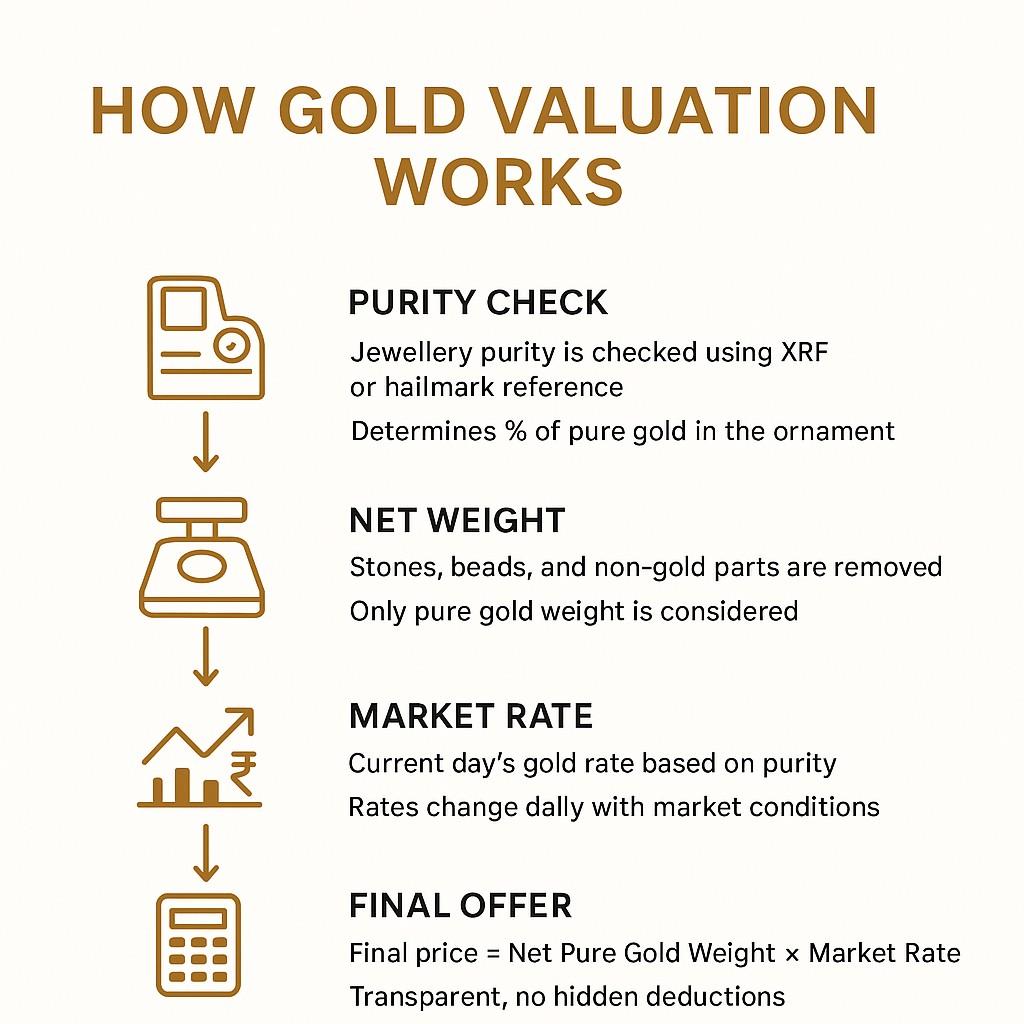
Understanding Gold Valuation: How Your Final Price Is Calculated
Before visiting any buyer, it helps to know the three elements that directly decide your payout. Understanding these will protect you from being underquoted.
1. Purity (Karat Level)
Most jewellery in India is not made of pure 24K gold. Common purity levels include 18K, 20K, and 22K.
A professional valuation uses non-destructive testing, such as XRF analysis, to determine the exact gold percentage without damaging the jewellery. This purity reading forms the base of the calculation.
2. Net Gold Weight
Only the actual gold content is valued.
-
Stones, beads, enamel work, and non-gold components are excluded.
-
A transparent buyer shows both gross weight and net gold weight clearly.
Understanding this distinction helps avoid confusion and unrealistic expectations.
3. Current Market Gold Rate
Gold prices change daily due to global market movements, currency fluctuations, and demand.
Checking the live gold rate from reliable financial sources before visiting a buyer gives you a reference point. This allows you to identify whether the quoted rate is reasonable.
Step-by-Step Guide to Selling Jewellery for Instant Cash
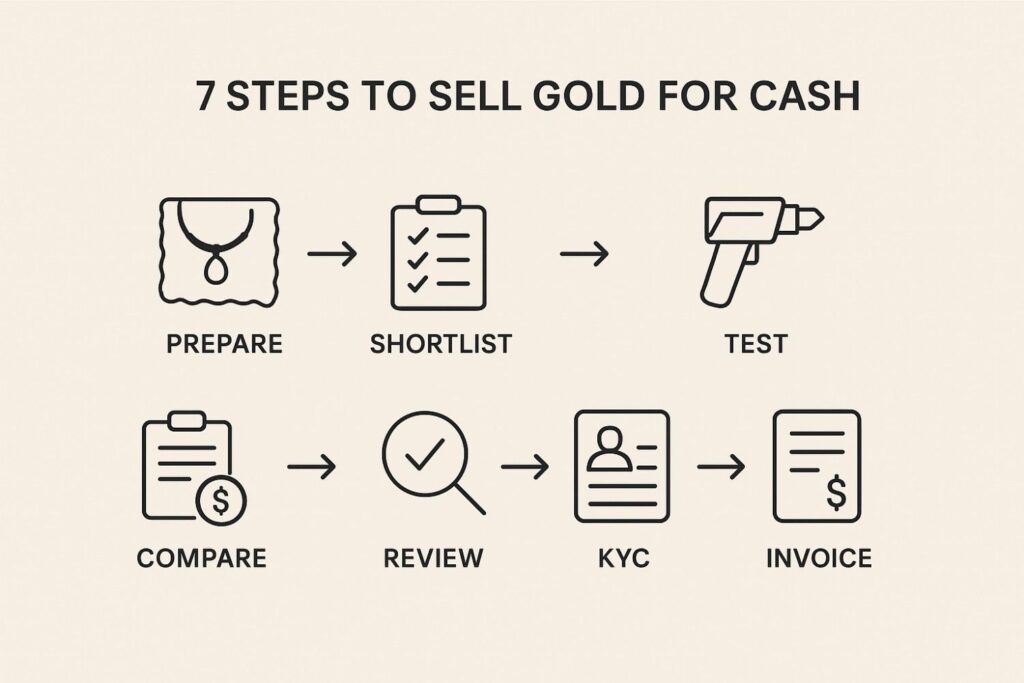
Selling gold becomes much easier when you understand what to do at each stage. The steps below follow a research-backed framework used in trusted financial and consumer-advice blogs, making the process clear even for first-time sellers.
Step 1: Prepare Your Jewellery
Simple preparation makes the valuation process smoother.
-
Clean the jewellery gently with a soft cloth.
-
Keep matching items together, such as earring pairs or bangles.
-
Carry any available bills or hallmark certificates if you have them. These are helpful but not mandatory.
Step 2: Shortlist Reliable Buyers
Not all buyers follow the same standards.
Look for buyers who:
-
Conduct purity testing in front of you.
-
Explain calculations clearly.
-
Avoid hidden charges such as melting or handling fees.
-
Provide written or digital valuation breakdowns.
These indicators matter more than brand size or store appearance. For sellers who want to understand how these standards are applied in practice, it helps to review how established buyers operate in Kerala and Hyderabad before visiting a branch.
Step 3: Get a Professional XRF Purity Test
Purity testing is the most important stage of valuation.
XRF testing allows buyers to:
-
Check purity accurately.
-
Avoid melting or scratching jewellery.
-
Show digital results instantly.
A professional buyer will perform this test in your presence and explain the reading.
Step 4: Collect Multiple Quotes
Getting at least two or three valuations helps you understand your jewellery’s true worth.
When comparing offers, ask:
-
What purity percentage was applied?
-
Which gold rate was used?
-
How was the final amount calculated?
This comparison alone can significantly improve your final payout.
Step 5: Review the Breakdown
A trustworthy buyer won’t just give you a number—they will explain it.
The breakdown should clearly include:
- Gross weight (total weight of the item)
- Net/pure gold weight (after excluding stones or non-gold parts)
- Purity percentage or karat
- Market rate used for calculation
- Final offer amount
If any line doesn’t make sense, ask for clarification. Transparent buyers will be happy to explain each detail, and asking questions ensures you fully understand how your jewellery was priced.
Step 6: Complete KYC & Receive Payment
Gold selling is a regulated transaction, which means basic KYC is mandatory.
Bring valid ID documents such as Aadhaar, PAN, Voter ID, or Driver’s License. Once the verification is done, you can receive payment instantly through UPI, IMPS, NEFT, or cash (subject to legal limits).
Step 7: Get a Proper Invoice
Never leave without a final invoice.
This document serves as legal proof of the transaction and protects you if any issue arises later. A proper invoice includes:
- Exact weight
- Purity reading
- Rate per gram
- Total amount paid
- Buyer’s company name, address, and signature
Keep it safely — you may need it for tax records, loan closures, or personal financial tracking.
Red Flags to Watch Out For
Consumer complaints across India show certain warning signs that often appear in dishonest or unregulated gold-buying shops. If you notice any of the following, it’s safer to walk away and find a transparent buyer.
❌They do not test your jewellery in front of you
If a buyer takes your jewellery to a back room for testing, you lose visibility and control over the process. This creates a risk of misreporting purity or mishandling your item. Reputable buyers always perform purity tests in full view of the customer.
❌They give only vague or handwritten estimates
A handwritten slip or a rough verbal quote usually means the shop isn’t following standard valuation procedures. Without a proper breakdown, you can’t verify how the final price was calculated. Honest buyers will always provide clear, printed or digital estimates.
❌They add hidden “melting” or “handling” charges
Some buyers melt jewellery before testing, which not only damages your item but also results in unnecessary deductions. Hidden fees are a common tactic used to reduce your final payout without you noticing. A trustworthy buyer will never charge melting fees for purity testing.
❌They pressure you to sell immediately
If a shop pushes you to “decide right now,” it may be trying to prevent you from comparing prices elsewhere. High-pressure tactics indicate a lack of transparency and fair dealing. A genuine buyer will allow you time to think and even encourage you to compare multiple offers.
❌They refuse to provide a proper invoice
An invoice is essential because it protects you legally and records all details of the sale. Shops that avoid issuing invoices usually want to operate without accountability. Never proceed with a transaction unless the buyer is willing to document it properly.
Tips to Maximize Your Payout
Getting the best value for your jewellery doesn’t depend only on where you sell—it also depends on how you prepare and time your sale. These practical tips can help you earn significantly more from the same piece of gold.
✅Check Rates Before Visiting
Gold prices change daily, and even small fluctuations can impact your final payout. Checking the live rate helps you understand what a fair offer looks like before you walk into a store. When you know the market rate, you’re less likely to accept an underpriced quote.
✅Sell During Stable Market Days
Sharp spikes or sudden drops in the gold market make buyers more cautious. During these periods, they may offer slightly lower margins to protect themselves from volatility. Selling when the market is stable usually results in a more consistent and fair offer.
✅Prefer Selling Hallmarked Jewellery
Hallmarked jewellery already comes with certified purity, which makes valuation faster and more accurate. Buyers feel more confident when purity is already verified, and that can lead to better offers. Even without a hallmark, XRF testing still works—but hallmarking adds an extra layer of trust.
✅Consider Sentimental Value Before Selling
Some jewellery pieces hold emotional value or can be repaired or redesigned instead of being sold for gold value. If a piece can be restored at a reasonable cost, it might be worth more as jewellery than as scrap gold. Always consider whether you truly want to part with it before melting it down.
✅Compare at Least 2–3 Buyers
Different buyers use different margins, and even a small difference can affect your payout significantly. By comparing multiple quotes, you get a realistic idea of your jewellery’s true worth. This simple step alone can boost your final amount by up to 12–18%.
Legal Factors You Should Know
Understanding the legal side of selling gold helps you avoid problems and ensures your transaction is fully compliant. These rules apply across Kerala and Hyderabad, and following them keeps your sale smooth and stress-free.
1. KYC Requirements
Gold selling is a regulated process, so buyers must verify your identity before completing the transaction. Carry valid ID proof such as Aadhaar, PAN, Voter ID, or Driver’s License. This step protects both you and the buyer, and helps prevent fraudulent or illegal transactions.
2. Gold Loan Releases
If your jewellery was recently released from a bank or finance company, you must carry the release or closure slip. This document proves that the item is legally yours and no longer under pledge. Without it, some buyers may refuse the transaction or offer a lower value due to incomplete documentation.
3. Tax Implications
If you earn a significant profit from selling gold—especially coins, bars, or investment-grade items—you may fall under capital gains tax rules. While most small jewellery sales don’t attract tax, high-value transactions might require proper reporting. Keeping your invoice safe helps in case you need to show proof during financial or tax assessments.
Conclusion: Make Your Gold Selling Experience Clear, Safe & Rewarding
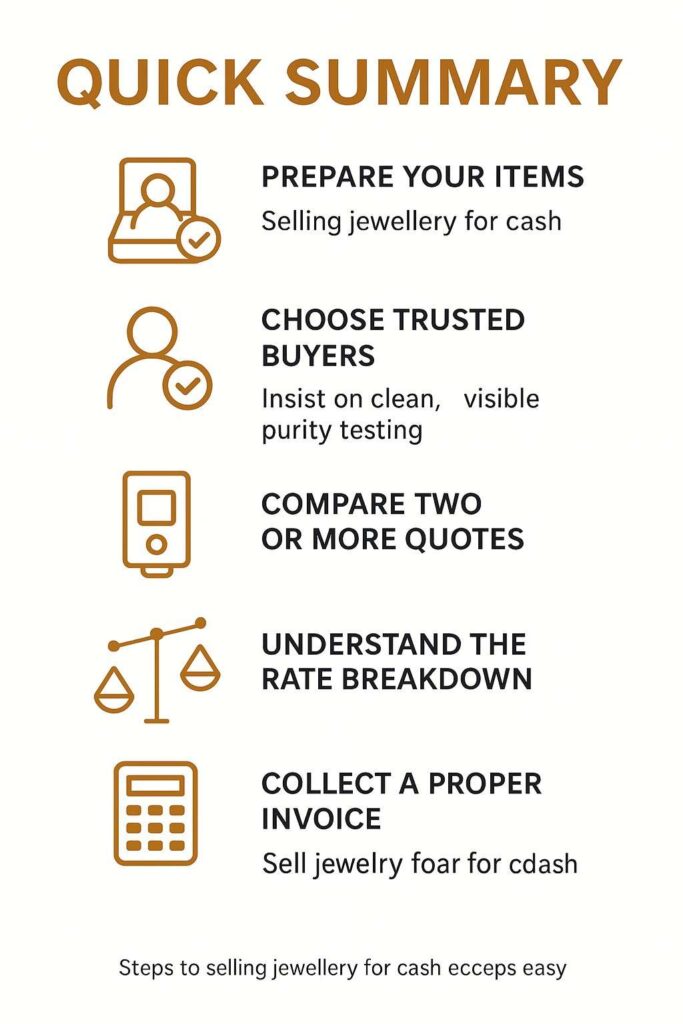
Selling gold is an important financial decision, and clarity at each step makes a real difference to the outcome. When you understand how purity is tested, how prices are calculated, and what transparent valuation looks like, the process becomes far more predictable and less stressful. Simple actions like preparing your jewellery, comparing a few buyers, and insisting on visible testing help protect you from underpricing and confusion.
A reliable gold-selling experience is built on clear processes. Licensed buyers who test jewellery in front of you, explain calculations openly, and provide proper invoices allow you to make decisions without pressure. With the right information and a calm, methodical approach, selling gold jewellery can be a straightforward way to unlock value when needed.
If you want to see how these standards are applied at a branch level, reviewing how professional buyers operate in Kerala or Hyderabad can offer useful clarity before you visit in person.
FAQs
Is the gold-selling process different in Kerala or Hyderabad?
The core process remains the same. Purity testing, weight calculation, market rates, and KYC apply everywhere. Differences usually lie in how transparently buyers explain the process and how clearly they present the valuation.
Do I need the original bill to sell gold jewellery?
No. Original bills are helpful but not mandatory. Purity testing and ID verification are more important for completing the transaction.
3. How is gold purity tested without harming my jewellery?
Most reputable buyers use XRF testing, a non-destructive method that scans purity without melting or scratching your items.
4. Why do different buyers offer different prices for the same jewellery?
Each buyer uses their own margin and calculation method. Offers also differ based on purity readings, gold rate used, and hidden charges.
Can I refuse the offer after valuation?
Yes. Valuation does not obligate you to sell. You are free to compare quotes and decide later without penalty.
9. How do I know if the gold rate used by the buyer is accurate?
You can cross-check live gold rates on trusted financial websites or apps before visiting the store.
Written by LIjo James